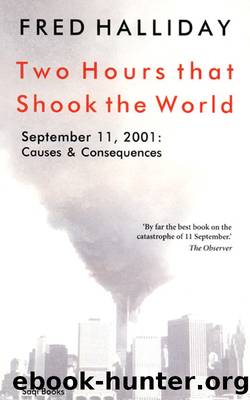
Two Hours That Shook the World: September 11, 2001: Causes and Consequences by Fred Halliday
Author:Fred Halliday [Halliday, Fred]
Language: eng
Format: epub
Tags: History, Political Science, Terrorism, Americas (North; Central; South; West Indies)
ISBN: 9780863567292
Google: ckMhBQAAQBAJ
Goodreads: 23057215
Publisher: Not Avail
Published: 2001-11-01T00:00:00+00:00
Islamophobia or anti-Muslimism
Such historicization and disaggregation are relevant to the issue of defining prejudice against Muslims.6 That there is such as a thing as âIslamophobiaâ is undoubtedly true. Recent examples in the British press are not hard to find.7 Elsewhere we can see similar trends: in Denmark the Peopleâs Party has made such hostility central to its programme;8 in 1998 Hollywood produced an alarmist film, âThe Siegeâ, focusing on Islamic terrorism â in marked contrast, be it said, to its indulgent treatment of Irish republicanism. Nor is this specific to the Christian or Jewish worlds. Perhaps the most striking instance of hostility to Muslims today is to be found in India. The BJP ran for re-election in 1997 on three anti-Muslim issues: rebuilding the temple at Ayodhya, removing separate legal codes for Muslims and ending the special status of Kashmir. Other policies â renaming Bombay after a Hindu goddess, rewriting history books â follow a similar logic.
The positing of a continuous, historic past of confrontation may not only be historically inaccurate but may ascribe cause to religion, an eternal factor, where other, more contingent and contemporary causes may be at work. It also misses the point about what it is that is being attacked: âIslamâ as a religion was the enemy in the past â in the Crusades or the reconquista. It is not the enemy now: Islam is not threatening to win large segments of Western European society to its faith, as communism did, nor is the polemic, in press, media or political statement, against the Islamic faith. There are no books coming out questioning the claims of Muhammad or the Quran. The attack now is against not Islam as a faith but against Muslims as people, induding, indeed especially immigrants. Equally, the âIslamophobicâ attack is against states that may be among the most secular in the world, as Saddam Husseinâs is. If we take the study as one of negative stereotyping, of what in German is called the Feindbild, the âenemy imageâ, then the enemy is not a faith or a culture but a people. Hence the more accurate term is not âIslamophobiaâ but âanti-Muslimismâ.
Use of the term âIslamophobiaâ may also convey two other, misleading associations. One is that the term reproduces the distortion, already discussed, that there is one Islam. âIslamophobiaâ indulges conformism and authority within Muslim communities: one cannot avoid the sense, in regard to work such as the Runnymede Report, that the race relations world has yielded, for reasons of political convenience, on this term.
Use of âIslamophobiaâ also challenges the possibility of dialogue based on universal principles. It suggests, as the Runnymede and Wilton Park reports do, that the solution lies in greater dialogue, bridge-building, respect for the other community: but this inevitably runs the risk of denying the right or possibility of criticisms of the practices of those with whom one is having the dialogue. Not only those who, on universal human rights grounds, object to elements in Islamic tradition and current rhetoric, but
Download
This site does not store any files on its server. We only index and link to content provided by other sites. Please contact the content providers to delete copyright contents if any and email us, we'll remove relevant links or contents immediately.
The Secret History by Donna Tartt(19088)
The Social Justice Warrior Handbook by Lisa De Pasquale(12190)
Thirteen Reasons Why by Jay Asher(8910)
This Is How You Lose Her by Junot Diaz(6887)
Weapons of Math Destruction by Cathy O'Neil(6280)
Zero to One by Peter Thiel(5802)
Beartown by Fredrik Backman(5754)
The Myth of the Strong Leader by Archie Brown(5507)
The Fire Next Time by James Baldwin(5446)
How Democracies Die by Steven Levitsky & Daniel Ziblatt(5219)
Promise Me, Dad by Joe Biden(5153)
Stone's Rules by Roger Stone(5088)
A Higher Loyalty: Truth, Lies, and Leadership by James Comey(4964)
100 Deadly Skills by Clint Emerson(4925)
Rise and Kill First by Ronen Bergman(4789)
Secrecy World by Jake Bernstein(4753)
The David Icke Guide to the Global Conspiracy (and how to end it) by David Icke(4720)
The Farm by Tom Rob Smith(4512)
The Doomsday Machine by Daniel Ellsberg(4490)
